Cinema Club x Perimetro - Virgilio Villoresi
Virgilio Villoresi is a director and visual artist who lives and works in Milan, where he's considered one of the leading contemporary Italian animation artists, specialized in stop motion and handmade animation techniques.
In 2021, he founded his production company Fantasmagoria to self-produce "Orfeo," his first feature film inspired by Dino Buzzati's "Poem Strip." The film, shot over two and a half years using 16mm film, stop motion, and optical effects from early cinema, premiered in the Out of Competition section at the 82nd Venice Film Festival.
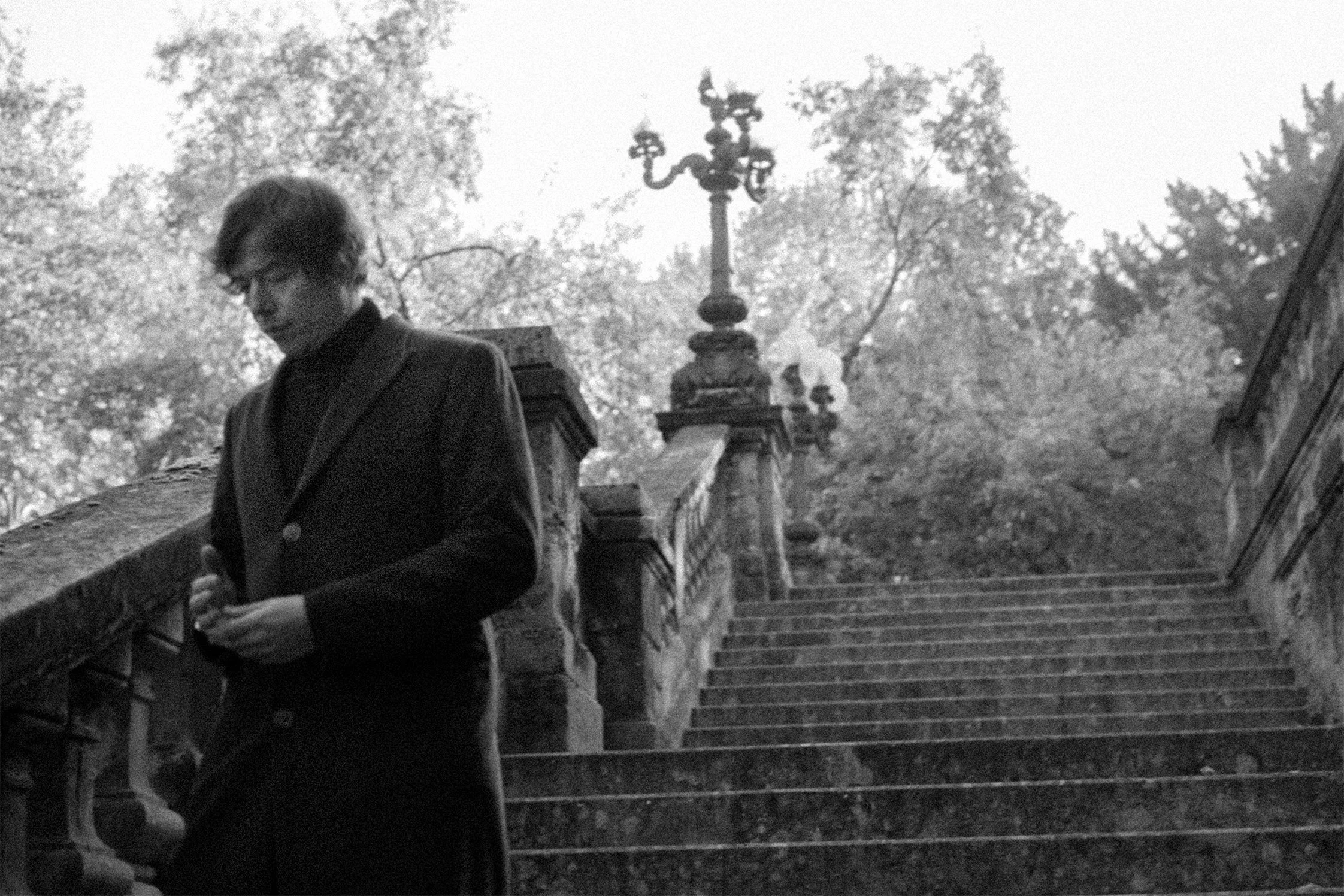
I met him in Porta Venezia to talk about the film and his handmade creative process.
Photos by Giovanni Massimo Zanusso
A film shot over two and a half years. That's already a wow, right? On one hand, you had a lot of time, which is precious when making a film. On the other, it's quite a challenge. I'm curious to hear about your process, how you made it, how it was produced.
First of all, I established my production company, Fantasmagoria, in 2021, and I applied for pre-production and development grants, and then later for selective production contributions. Then we applied for tax credits. In the end, we managed to get all these contributions and from there, quite boldly, we started production. Bold in the sense that there were no co-productions, no external production companies helping us out. And basically very few private investors.
I spent some of my own savings, made through advertising work, and in the end we managed to close the budget and we started.
We didn't shoot for two and a half years straight, but in tranches. Because between one tranche and another, for example, if I had a commissioned job, I would typically do it and then reinvest the money in the film.
You said it's a handmade film – that's a word that really stuck with me because we live in a time when everything tends to become immaterial. You went in the opposite direction.
Yes, I chose to do it by hand first of all because of a natural inclination toward making things manually, toward a search for wonder and amazement that I feel when I see a trick before my eyes.
For example, the phantom aura effect we created in-camera – we created an actual cross-dissolve through the "Schüfftan effect," which is a sheet of glass positioned at 45 degrees to the camera axis with the actress reflected while interacting with the actor filmed beyond the glass. This is the sublimation of this concept of craftsmanship – we created these cross-dissolves in camera with this trick that Fritz Lang also used in his films.
So you drew on techniques from a hundred years ago?
Yes, but stop motion itself was the first trick in cinema. Some attribute the first stop motion animation to Segundo de Chomón, others to Émile Cohl's short film "Fantasmagorie." Anyway, these are all effects born just a few years after cinema was invented. So yes, there's stop motion which is a primitive effect, linked to primitive cinema, and then there are also other special effects they used in the twenties and thirties. But even the use of 16mm film itself is a way to blend all this and give it a material, suspended flavor.
It's like you entered a kind of space-time capsule, because for two and a half years it was like I completely ignored what was happening outside.
It was a journey. A journey like the film itself, a sort of dreamlike journey. Making it was also a journey, not just the film's story. The set changed every time – we went from a forest to an interior, to an art nouveau venue set design, to a somewhat infernal corridor. In short, the place where I was shooting was constantly changing for about two and a half years.
You started very boldly and then your film was selected for Venice. When you started shooting it, did you already have such an important goal in mind?
Yes, I generally wanted to make a great film. I've always had the ambition to do something unique in the Italian and international landscape. In every shot I tried to give my best and create something personal. Something that reflected a very strong artistic side of me.
It was a very free film in that sense.
I saw so much of you as a child, even those Super 8 shots of your mother.
Yes, that was a tribute to my mother's passion for dance. I used the cinematic medium to unite the live action part – with the actress and the dance company I called to my studio – and the found footage related to my mom's story, my mom dancing. There's an edit that unites two great passions: my mother's passion, who dedicated an entire life to dance, and my passion for cinema. They came together in that moment, in that segment of the film.
It's quite a commitment to dedicate your life to cinema.
Oh yes, it was an act of courage and determination. Then such a long film was a bit of a leap in the dark, because it wasn't a commissioned film and it didn't even have distribution behind it. I found distribution later, after the Venice Film Festival. It's thanks to the festival that I found international distribution – first with True Colours and then with Double Line for Italian distribution – thanks to the exposure I got. But before that I had nothing. I risked getting into debt and making a film that no one would be able to see.
Obviously you think about it when you start. After months of shooting, when you also start struggling financially, you say: "What the fuck am I doing? I'm crazy." But at the same time a part of me pushed me to keep going, to finish, because I was starting to see that something beautiful was being born.
It's a very powerful thing, a director who opens a production company, invests his own money, makes his film. But on the other hand, I wonder, isn't it also a sign of how limited the industry is in Italy? In the sense that you wanted to do something different from the Italian landscape, but is this the only way to expose yourself so much?
For me yes, it was the only way. Before opening the production company, I tried to propose first the subject and then the screenplay to other film companies. But I always had the impression that they didn't give me enough creative freedom. I wanted to make my own personal film, I didn't want to compromise in any way. So I thought the only way was to be my own producer. It was also difficult to sell to larger production companies that obviously need to understand how to position it, what kind of distribution to give it.
But after Venice did you open up contacts to make a new film?
Yes, now I'm working – I'm still in the embryonic stage – but I'm already working on a second feature. I'd like to maintain the same asset of production freedom in the second film too.
Now it's easier to find a co-production because I can already show the final result.
So in negotiations I can say "look, this is how I work." I'd still like to shoot the second film in my studio, in my atelier, because that's my way of working.
My way of shooting has a very strong playful aspect. I like to play, to change the actors' lines, or the arrangement of the set, the lighting, even on the morning of the shoot. I want to have that kind of freedom.
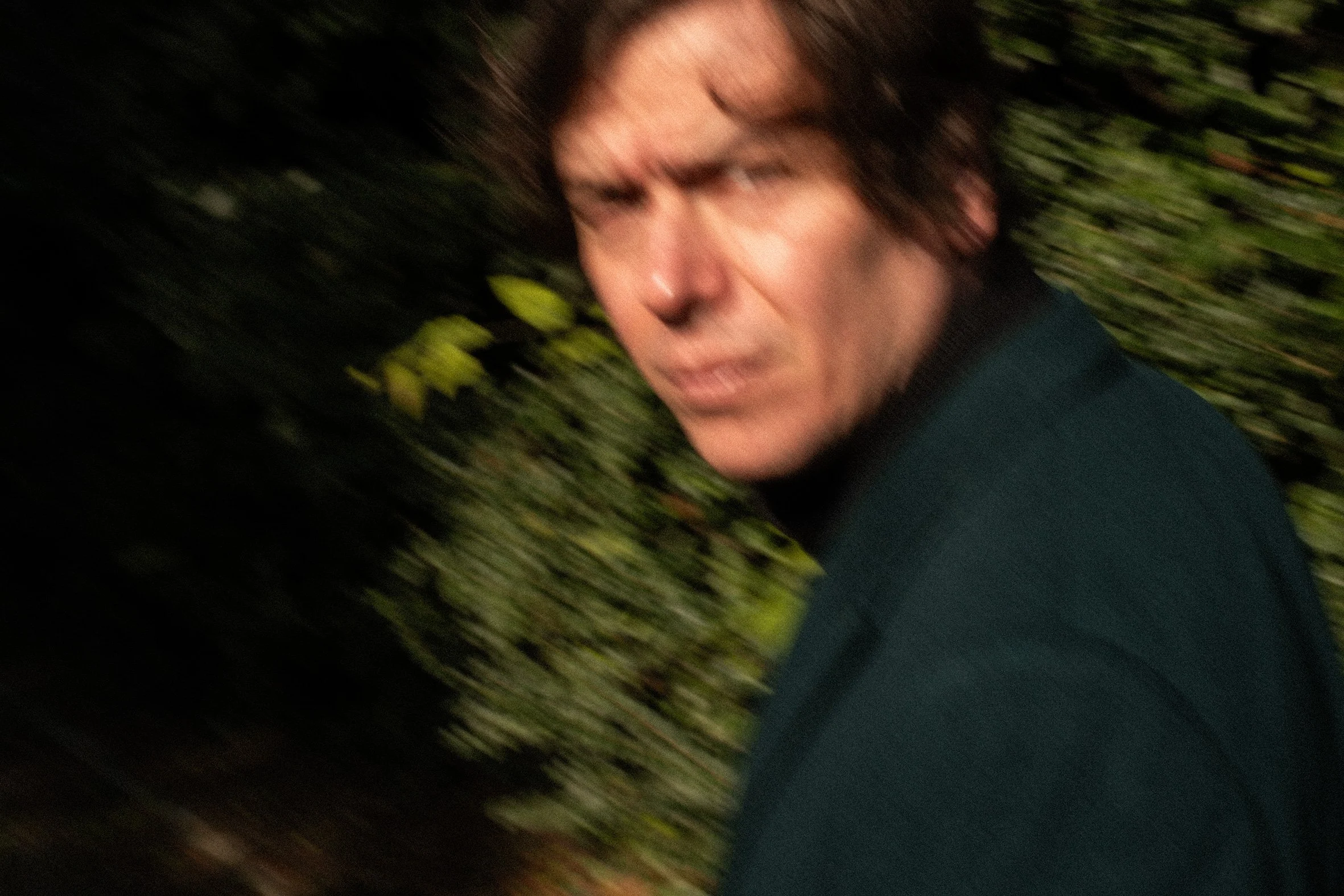
Milan is also a bit of a protagonist in your film, right? It's almost a character in the film itself and it's almost an ode to this city. What did you want to say?
Milan has now become my city because I've been here for over 15 years, I really feel close to it. And in some ways I love it too, there are some beautiful views. I represented Milan in a somewhat suspended way, a bit out of time, with a strong dreamlike dimension. All the studio reconstructions of Milan views and the miniatures helped me a lot. The light allowed me to create these types of atmospheres. It's a Milan filtered both by Buzzati's imagination but also by my artistic perception.
It's not a realistic Milan, but inserted in the film's context. The secret was to rebuild everything in the studio, because that's where you have total control of the light, the props, the sets, these large backlights that we printed. They were also quite pictorial in some cases. So it's like a Milan filtered through my fantasy, coming directly from my inner world, from my deep vision filtered by what I consider beautiful.
And how do you experience Milan today? In reality?
In reality I live seventy percent of the time in my studio, locked up making animations for clients or working on the new project. In the case of Orfeo I was closed inside this warehouse for two and a half years. So I experience it between my studio and my home and maybe I manage to carve out some time to go to the cinema, to exhibitions…
Right now I'm living a fairly quiet life honestly – I've kind of let go of the social aspect, also because I always feel this urgency to make art. So the older I get, the more if I'm not making art I feel like I'm wasting time. I try to stay as much as possible in my atelier, in my space, where I produce.
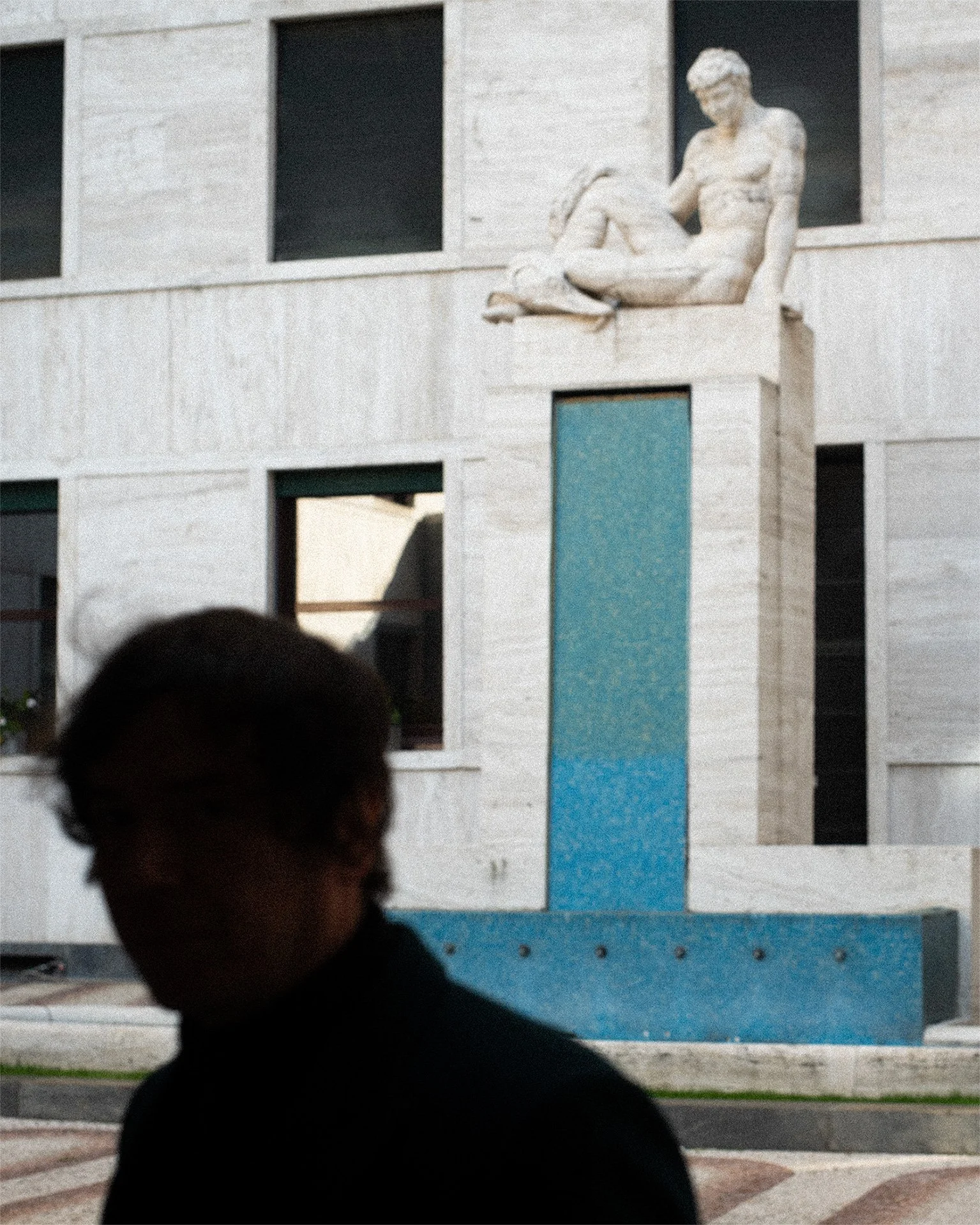
I'm also very fascinated by the artists, the designers who worked here, especially in the twentieth century. Even in my film I cited an architect I love very much, Piero Portaluppi, particularly the arch near Porta Venezia. And there – in the door that divides the world of the dead from the world of the living – I reconstructed lightning bolts that are the decoration of this great arch. I took inspiration directly from there. Then I made them three-dimensional with a decorative set intervention. It's a tribute to a great figure.
Do you think Milan has less artistic breath now?
I don't know, let's say I would very much like Milan to become a second filmmaking hub. I think it would be wonderful, because there are many very talented directors.
You're also a bit of an emblem of a director who started making commercials and music videos and then managed to break into cinema. Which doesn't happen to many.
But exactly! But I had to do it myself with my production company. Otherwise I would never have been able to make Orfeo, let's be honest. It's thanks to my production company. I took the initiative, which I think was courageous, but in the end…
Give me some names of Italian directors you admire from the past or present.
I think there are some excellent young Italian directors, by the way almost all of them shoot on film.
I really like Sara Fgaier, who made her debut last year with "Sulla terra leggeri," presented at Locarno. It's a very beautiful film, I really enjoyed it, she also shot on film. She made quite extensive use of found footage, with vintage archival footage.
I also think the works of Simone Massi, Francesco Sossai, Alessio Rigo de Righi, and Matteo Zoppis are very interesting. They went to Cannes this year. Films highly appreciated by critics, first or second works. I really like Davide Manuli, who's also a friend. Now I know he's probably about to shoot his next film project.
I don't think Italian cinema is doing badly, especially that of the new generation. It would be interesting to start talking more about a sort of new wave, because I think there is one, it exists, it's tangible. By the way, all these directors are united by a material search for the image, because almost all the ones I mentioned shoot on film. So it's interesting, very interesting.
Your film has a very strong contribution from other people too: cinematography, set design, costumes… How did you choose the people to work with?
They're all people who already worked with me in advertising and embraced the project. With Sara Costantini there was a deep fusion, as if we touched each other deeply.
She also likes things from the twentieth century, the Victorian. In Orfeo she was able to draw on all this culture she's always loved. So we got along great. I asked her to do the costumes and imagine them as if they came directly from the sets or the wallpapers I used in the film. It was very interesting to work with Sara.
Then also Marco De Pasquale, who already had experience with film. With him too there was a good synergy. At first we had to understand each other a bit, especially regarding the miniatures. But then we found our way of communicating and I think he was really good with light, he managed to give a different aura, interesting, very beautiful. Both on objects and on flesh-and-blood people, on actors, on characters. He did a fantastic job.
The set designers I collaborate with shared the space with me at that time, the set design came directly from the same warehouse because we worked together, we shared the same space. When I shot Orfeo they would build the sets, turn the dividing wall and enter… so it was very convenient.
With everyone a group of friends was created who in the end had fun tackling this journey full of unforeseen events and difficulties, but we helped each other overcome them.
You have a son and you managed to reconcile this film gamble with fatherhood. Let's say there's also this complexity in your life. Did being a father inspire you, push you, give you strength?
Absolutely yes. It's as if my son was present in every shot, in every choice I made there was a bit of my son's shadow, because somehow, when I came home I wanted to show him what I had done. I had a father who didn't recognize me, so I've always missed this contact with the father figure. I've always idealized it a bit. I never had this father-son bond.
With my son Martin I wanted to share everything, it was almost a game of reflections. I shared my games with him – meaning the film's scenes – because for me it was really a game, as if he were also my companion. And it was beautiful because he also came to the set to see some sets and he was amazed.
It's an experience I shared from the beginning with my son and it gave me great strength, especially in difficult moments, because at a certain point when I said to myself "But why am I doing this? Where is this taking me?" I was tied to an unspoken promise with my son, to finish it and then show him the final work. This gave me strength, also not to disappoint him. I managed to finish also for this reason, to finally show him the film.
Cinema as an act of generosity and not as an act of ego
Yes, because cinema saved my life when I was a teenager. I was a bit lost. So I see it as an act of generosity and an act of love toward cinema itself. I do it as if it were a sort of divinity and I try with my film to give something to this divine entity, to bring my contribution, because truly in a sense my God is cinema.
I watched films when I was little and it was almost a form of prayer. Not having had a father, I couldn't understand what friendship was, what love was. So I watched films to learn everything about life. For me cinema was a form of initiation into life. And so in a sense it straightened me out. I owe a lot to this art and that's why I want to bring my contribution. Setting aside questions of ego too, I don't care about that. I do it only out of love for this discipline that for me is a sort of religion, I don't know how to say it, a faith.